Watch: University of Cambridge Visualisation Shows How Bitcoin Mining Fell in China Even Before Crackdown
Watch: University of Cambridge Visualisation Shows How Bitcoin Mining Fell in China Even Before Crackdown
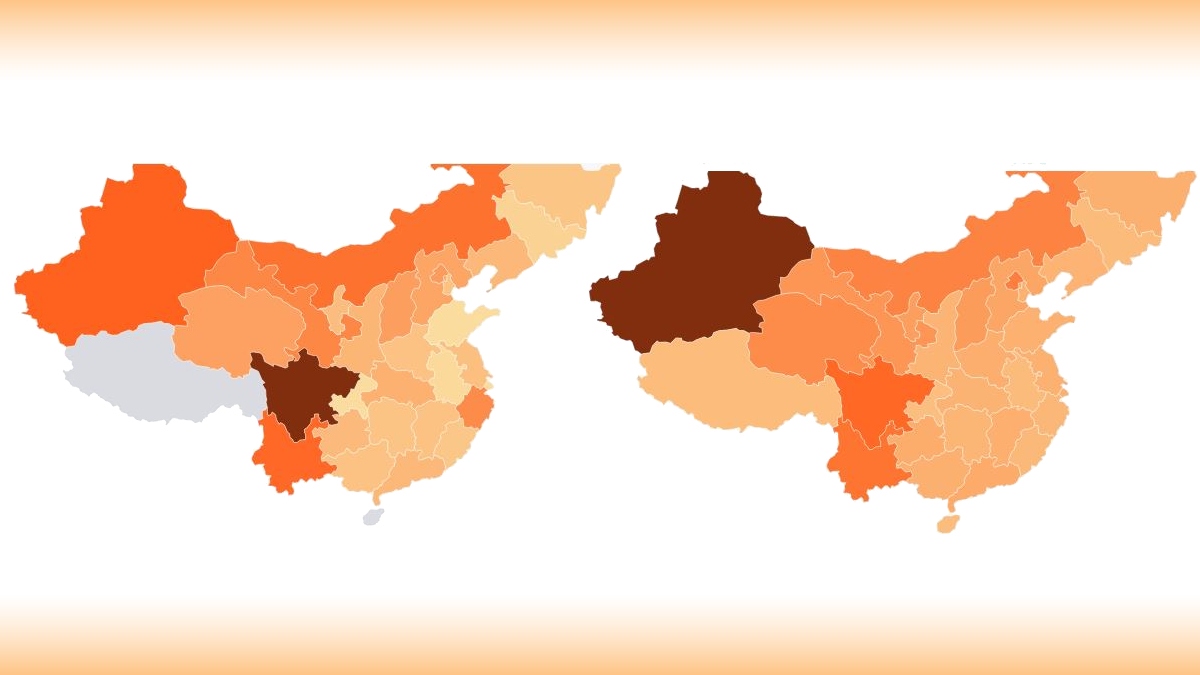
China's share of mining fell from 75 percent in September 2019 to 46 percent within less then two years.

Photo Credit: Screenshots/ Cambridge Centre for Alternative Finance
Cambridge index shows how China's average monthly hashrate changed from September 2019 (L) and April 2021
The Cambridge Bitcoin Electricity Consumption Index by Cambridge Centre for Alternative Finance (CCAF) shows how notably Bitcoin mining fell in China even before the latest nationwide crackdown began. It shows that China's share of mining fell from 75 percent in September 2019 to 46 percent in April 2021, two months before the country banned cryptocurrency mining. Unlike trading, where existing Bitcoins are purchased or sold, mining is the process of creating new Bitcoins using heavy power-consuming computer rigs.
Cryptocurrency mining requires enormous amounts of electricity and contributes massively to global emissions. The CCAF research took into account the average monthly hashrate share of countries, thinking of it as the collective computing power of miners in that particular region. A hashrate signifies the total computation power being used to mine and process transactions in a blockchain.
Click here to check out the visual map. On the map, you can choose to go back to September 2019, or any other month after that until April 2021, and click on the 'play' icon to note the change in average monthly hashrate.
No comments: